
In the specialised world of collecting, value is determined by a confluence of rarity, historical significance, and cultural impact. It is a rare occasion when a single item exemplifies all three qualities so completely that it transcends being merely a “rare book” and becomes, unequivocally, the ultimate collectible.
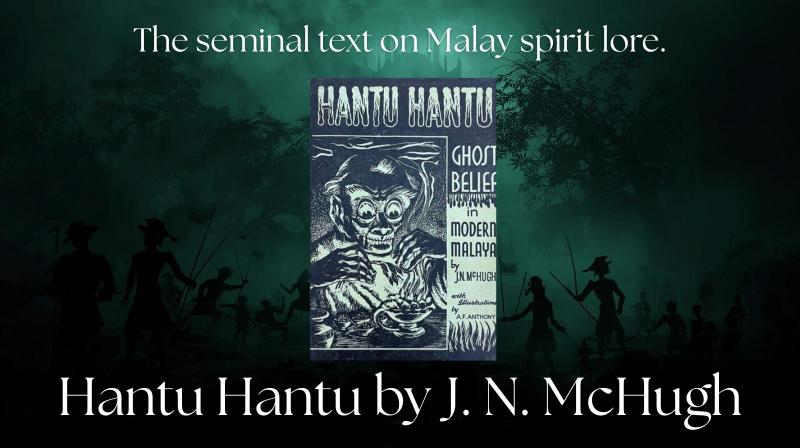
J.N. McHugh’s Hantu Hantu (Eastern Universities Press, 1959) is one such item. Priced at RM 1,200, this copy is not merely for sale; it is offered as a cornerstone acquisition for the discerning collector or institution. Here is why.
The Benchmark of Rarity
The first question of any serious collector is: “How many exist?” In the case of this second edition, the answer is: effectively none on the open market. A thorough review of the last decade of international rare book listings reveals a near-total absence of copies for sale. This isn’t a book that appears with minor frequency; it is a ghost, whispered about in bibliographic circles but seldom seen. When a copy does surface, it is quickly absorbed into a permanent collection, vanishing from public view for another generation. This isn’t just scarcity; it is cultural evaporation.
Enduring Academic Relevance
A book’s true value is proven by its longevity as a primary source. Hantu Hantu is not a forgotten relic; it is a living text continually cited in modern academic works on Southeast Asian anthropology, religious syncretism, and post-colonial studies. Scholars like Syed Hussein Alatas and modern ethnographers return to McHugh’s work because it provides an unparalleled, snapshot-like fidelity of Malay folk beliefs at a critical mid-century juncture. It is the definitive reference against which later studies are still measured. To own this book is to own a piece of the academic bedrock.
The Provenance of the Press
The publisher itself, Eastern Universities Press Ltd., was an institution of immense historical importance in the intellectual development of post-war Singapore and Malaya. Its publications were scholarly, authoritative, and pivotal in shaping regional discourse. A book from this press is more than paper and ink; it is an artefact from the golden age of Singaporean publishing, carrying with it a weight of authority that modern reprints cannot replicate.
A Preserver of Lost Knowledge
McHugh himself lamented the gradual extinction of the beliefs he documented. Today, decades later, much of this knowledge has indeed been lost to urbanisation and modernisation. This book, therefore, performs a vital function: it is a preserved archive of a world that has since vanished. It captures the nuances of the bomoh, the specific charms against the penanggalan, and the cosmology of the hantu in a way that is no longer possible to record. It doesn’t just describe history; it contains it.
This particular copy, with its intact cover and clean, unmarked pages, has been preserved with the care such a important work deserves. It is a direct link to that unseen world, offered here in remarkable condition for its age.
This is a rare opportunity to acquire a key text of Southeast Asian anthropology. Its combination of profound cultural significance and extreme market scarcity makes it a worthy centrepiece for the most serious collections.
> > Serious Enquiries Regarding This Collectible Are Invited. Contact Us To View By Appointment. <<
[→ Tap here to view this rare book in our Collector’s Corner]